Recoverable Capability · RLVR · Mathematical Reasoning

ReSI-Math

Exploring Recoverable Capability Frontiers for Efficient Reasoning Improvement

Yao Cui Zhen Yang Yuandong Wang Yangfu Zhu Tianyu Wo Zhenzhou Shao
Project page for ReSI-Math
Paper Overview

Abstract

Reinforcement learning with verifiable rewards (RLVR) has become an effective approach for improving mathematical reasoning in large language models. However, a fundamental question remains: when a model fails to solve a problem, does it truly lack the underlying capability? ReSI-Math shows that direct failure does not necessarily imply inability. Some reasoning failures can be recovered by exploring the model's own trajectories, exposing a recoverable capability frontier: a policy-dependent region where solutions are not reliably generated through direct decoding but can be elicited through trajectory-level search.

ReSI-Math uses Self-Judge-guided evolutionary search to identify recoverable failures under a fixed policy and adaptively selects frontier problems for sequential RLVR as the policy evolves. On Qwen3-VL-8B, correct–incorrect trajectory crossover produces 272 verifier-confirmed correct offspring from 621 attempts (43.8%). After three sequential one-shot RLVR stages, the average performance on MATH500 and WE-MATH improves from 78.71 to 80.16.
43.8% Verifier-confirmed correct crossover offspring
272 / 621 Successful crossover attempts on Qwen3-VL-8B
78.71 → 80.16 MATH500 + WE-MATH average after three stages
3 Sequential one-shot Solver-RLVR stages
Core Idea

Failure is not always inability.

ReSI-Math separates what a policy can reliably express from what can still be recovered through bounded search over its own trajectories.

Recoverable Capability Frontier

A problem can be difficult under direct generation while still admitting a verifier-confirmed solution after structured trajectory recombination. This creates a policy-dependent frontier between directly expressed capability, recoverable capability, and currently unexplored capability.

Direct Generation Sample K trajectories under the current policy.
→
Structured Search Self-Judge-guided evolutionary crossover probes latent recoverability.
→
RLVR Consolidation Recovered problems become policy-improvement targets.
Methodology

A four-stage recursive improvement loop

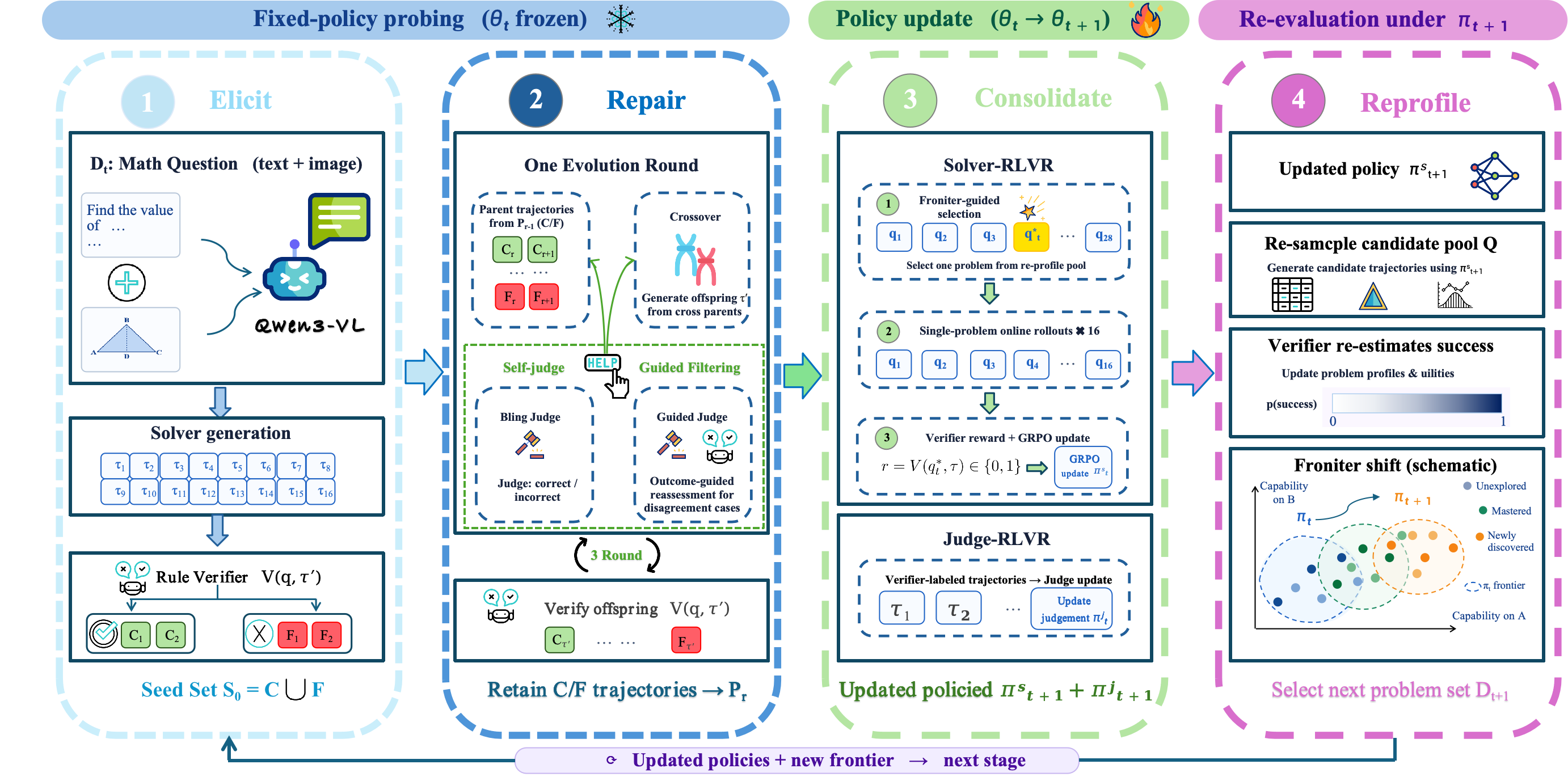
ReSI-Math decomposes capability exploration and learning into Elicit, Repair, Consolidate, and Reprofile.

01

Elicit

Probe the current policy with multiple direct rollouts and use a rule-based verifier to identify correct and failed trajectories.

  • Fixed-policy trajectory sampling
  • Verifier-confirmed C/F partition
  • Localize candidate frontier regions
02

Repair

Hold model parameters fixed and test whether failed reasoning can be transformed into correct reasoning through Self-Judge-guided evolutionary search.

  • Blind / Guided Self-Judge
  • C–F and F–F crossover
  • Verifier-confirmed failure-to-success transitions
03

Consolidate

Convert recovered capability signals into parameter-level learning through dual-signal RLVR.

  • Frontier-guided top-1 problem selection
  • Single-problem Solver-RLVR
  • Verifier-labeled Judge-RLVR supervision
04

Reprofile

Re-evaluate the candidate pool after each policy update because the most informative frontier problem changes as the policy evolves.

  • Re-sample candidate problems
  • Update success profiles
  • Select the next frontier target
Overview of ReSI-Math framework

Figure 2: Overview of ReSI-Math, including four stages: Elicit, Repair, Consolidate, and Reprofile.

Main Results

Recoverability provides an efficient learning signal.

The main 8B results show both successful trajectory repair and cumulative gains from policy-adaptive sequential one-shot RLVR.

Key quantitative findings

Crossover recovery 272 / 621
Offspring success rate 43.8%
Frontier-guided single-problem avg. 54.16
Random-selection baseline avg. 53.31

Policy-Adaptive Sequential RLVR Training Dynamics

DEV192 checkpoint trajectories for the 8B backbone. Q1, Random-Q1, and Fixed-Sequential are first replayed together on the same 0–700 step axis. Their completed trajectories remain visible while the selected Q1 checkpoint is translated to the origin to initialize Q2. Q2 is then overlaid on the existing curves, followed by the same selected-checkpoint transition from Q2 to Q3.

Current stage Q1 · 0
Adaptive selected checkpoints: Q1@500, Q2@500, and Q3@650.  |  Baseline DEV-best checkpoints: Random-Q1@400 and Fixed-Sequential@250.
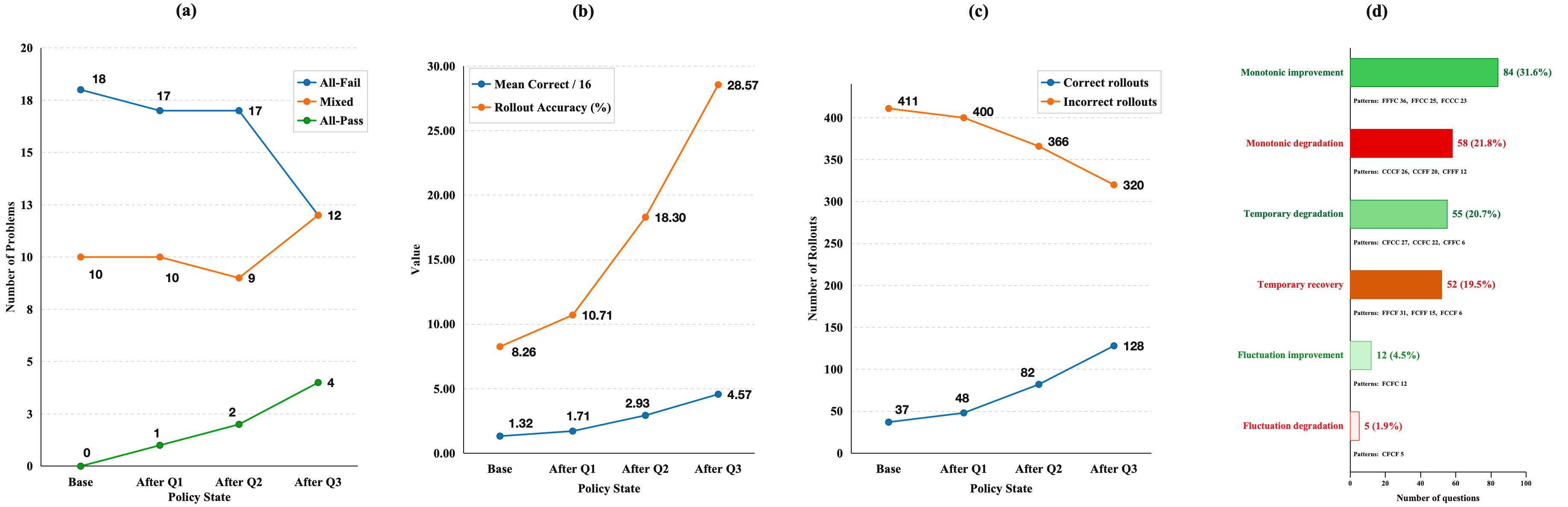
Rollout-profile dynamics of ReSI-Math

Figure 1: Rollout-profile dynamics over the 28-problem candidate pool and the validation set.

Project Status

Updates

2026-10
ReSI-Math manuscript and project materials prepared for public release.
Coming soon
arXiv paper, public code, checkpoints / experiment assets, and reproducibility documentation.
Citation

Cite ReSI-Math

Replace this placeholder with the official arXiv / proceedings BibTeX once the public record is available.

@misc{resi_math_2026, title = {ReSI-Math: Exploring Recoverable Capability Frontiers for Efficient Reasoning Improvement}, author = {Yao Cui and Zhen Yang and Yuandong Wang and Yangfu Zhu and Tianyu Wo and Zhenzhou Shao}, year = {2026}, note = {arXiv preprint} }